TABLY: an AI spreadsheet
What did I actually build
A spreadsheet application that democratizes data science through natural language aims to bridges the gap between traditional spreadsheets and enterprise BI tools by combining deterministic calculation engines with probabilistic Large Language Models (LLMs).
Tech Stack
Core Innovation: The Neuro-Symbolic Architecture
The system uses LLMs not to guess answers, but to orchestrate rigorous, deterministic tools. This hybrid approach ensures that while the interface is natural language (probabilistic), the execution is mathematical (deterministic), solving the AI hallucination problem.
Key Technical Achievements
1. Custom Formula Compiler & Parser
Built a production-grade formula compilation pipeline from scratch, capable of parsing and executing 200+ Excel-compatible functions.
- Recursive Descent Parser: Tokenizes formulas into Abstract Syntax Trees (AST)
- Type-Safe Evaluator: Executes AST nodes with type checking and error handling
- Circular Reference Detection: Stack-based algorithm prevents infinite loops
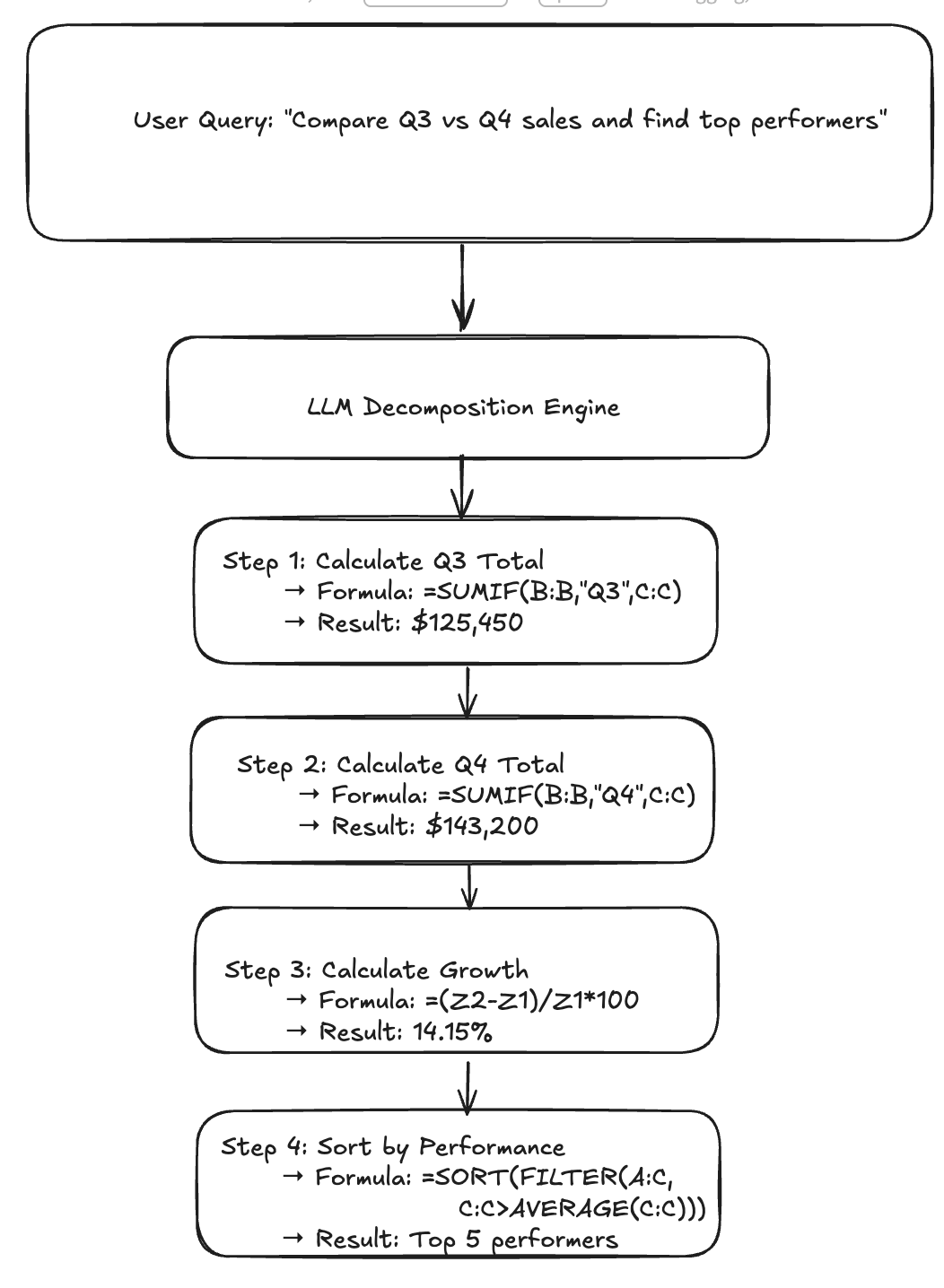
2. Multi-Step Query Engine
A revolutionary Chain-of-Thought reasoning system that breaks complex business questions into sequential, deterministic steps.
3. Dependency Graph Engine
An advanced topological sorting system that tracks formula dependencies and optimizes recalculation.
| Dataset Size | Without DAG | With DAG | Improvement |
|---|---|---|---|
| 100 cells | 12ms | 3ms | 4x faster |
| 1,000 cells | 450ms | 45ms | 10x faster |
| 10,000 cells | 18s | 420ms | 43x faster |
4. Pivot Table Engine
A complete OLAP (Online Analytical Processing) implementation for multi-dimensional data analysis. Supports grouping, aggregations, filtering, and nested grouping.
Technical Deep Dive: Formula Parser
The parser uses a Recursive Descent approach with operator precedence climbing.
Why this approach? O(n) time complexity, single pass, easy to add new operators, and mirrors mathematical grammar.
🔗 Links: Try it out yourself